How to Teach Definite Integration | A Level Maths (Year 1 Pure)

Curriculum Hub → Maths Lessons → Algebra → Integration → How to Teach Definite Integration | A Level Maths (Year 1 Pure)

Definite integration is the first place students apply the Fundamental Theorem of Calculus to get an actual number rather than a function plus a constant. This brief is built for planning, not revising: a quick content refresher, a video walkthrough you can watch back or set for cover, a suggested lesson sequence, and four exam questions ready to project at the end of the lesson.

Video refresher: Evaluating Definite Integrals Made Easy

View on YouTube

What students need to know

  • Definite integration applies the Fundamental Theorem of Calculus with a lower limit a and an upper limit b: ∫ₐᵇ f'(x) dx = f(b) − f(a).
  • No “+c” is needed — it appears in both f(a) and f(b) and cancels when you subtract. Worth putting the cancellation on the board explicitly, since it’s the question students ask most.
  • Notation matters for method marks: integrate first, write the result in square brackets with the limits after the closing bracket, then substitute.
  • Not every integral is in an integrable form straight away — expanding brackets or splitting a fraction into separate terms is often the first step (see the worked example in the video).

Suggested lesson sequence

  1. Starter: recap indefinite integration of powers of x, including negative and fractional indices — this is the prerequisite that trips students up here, not the new content itself.
  2. Teach: introduce the definite integral notation and the “+c cancels” argument, then model two examples on the board — one direct powers-of-x integral, one that needs expanding or rewriting first.
  3. Practise: worksheet from the lesson pack, moving from straightforward evaluation to “find k” problems where the limit itself is the unknown.
  4. Plenary: project the four exam questions below and take answers on mini-whiteboards before revealing each solution.

Misconceptions to flag

  • Adding “+c” out of habit, even though it’s not required for a definite integral.
  • Substituting the lower limit but only subtracting part of the bracket, rather than the whole evaluated expression.
  • Skipping the expansion/rewrite step and trying to integrate a product or a fraction term-by-term as it stands.
  • Trusting a calculator’s decimal output as the final answer when the question asks for an exact value — a good moment to show a calculator alongside the algebra, as in the video.

The full slide deck and differentiated worksheet for this lesson — including the starter, worked examples, and practice questions referenced above — are available in the Definite Integrals lesson pack with a Mr Mathematics membership.

Exam Questions

Mr Mathematics question card: find k, where k > 0, given that the definite integral from 1 to k of (1 + 1/x²) dx equals 15/4.

Mr Mathematics question card: evaluate the definite integral from 2 to 4 of (x³ + cube root of x) divided by 2√x, dx.

Mr Mathematics question card: find the value of the positive k such that the definite integral from k to 5 of (2x − 1) dx equals 20.

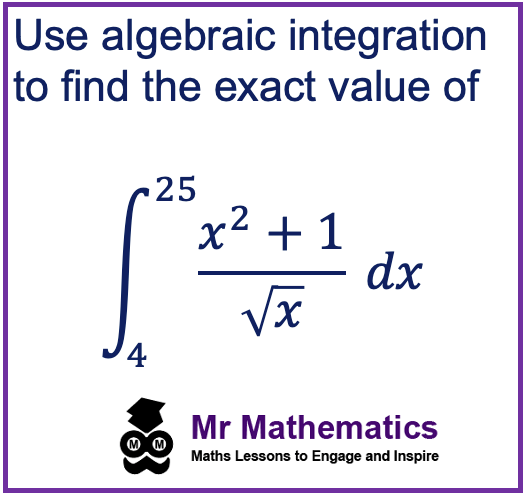
Mr Mathematics question card: use algebraic integration to find the exact value of the definite integral from 4 to 25 of (x² + 1)/√x, dx.

Want the full lesson, worksheet, and answer key ready to teach from? Grab the Definite Integrals lesson pack. View all integration lessons here.

FAQs: Teaching Definite Integration

Do students need indefinite integration secured before this lesson?

Yes, this lesson assumes students can already integrate powers of x, including negative and fractional indices. If that’s shaky, use the starter to recap it rather than folding it into the main teaching, or the lesson will run long.

Why isn’t “+c” needed in definite integration?

Because the constant appears in both f(a) and f(b) and cancels out when you subtract one from the other. It’s worth showing this cancellation explicitly on the board once, since it’s the question students ask most.

What’s the most common mistake to flag before students start?

Forgetting to expand brackets or rewrite a fraction into separate terms before integrating, and substituting the lower limit but only subtracting part of the bracket rather than the whole evaluated expression.

How long does this lesson take to teach?

Typically a single lesson, around 50 – 60 minutes, covers the method and standard evaluation questions. If you’re including “find k” problems where the limit itself is unknown, give these a larger share of the practice and plenary time” they usually need more scaffolding.

Is this lesson suitable for AS-Level as well as Year 1 Pure?

Yes, definite integration is the same content whether it sits in an AS-Level or Year 1 Pure scheme of work, so the lesson pack works for either.

Want the full lesson, worksheet, and answer key ready to teach from? Grab the Definite Integrals lesson pack.

Mr Mathematics Blog

Developing Mathematical Thinking Beyond Procedural Fluency

A research-backed case exploring why over-reliance on automated math homework platforms and repetitive worksheets lowers student expectations, and how departments can build genuine mathematical thinking.

Converting Between Fractions, Decimals and Percentages

How to teach converting between fractions, decimals and percentages.

From Key Skills to Deep Connections: Problem Solving in Secondary Maths

Four problem solving lessons to develop student’s mathematical reasoning and communication skills.