Differentiated Learning Objectives
When I teach how to add and subtract numbers in standard form, I use the starter activity to ensure students know how to convert ordinary and scientific numbers.
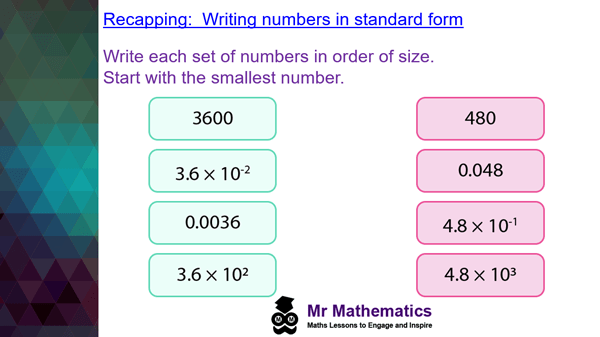
Prompts / Questions to consider
Click here to view the video.
There are two methods students can use to add and subtract numbers in standard form. The first method is to write the numbers using the same power of ten. The second method is to convert the numbers to decimal form.
Consider 2.4 x 10⁵ + 1.68 x 10²


Prompts / Questions to consider
I leave about 12 minutes for the plenary. I like this question because it challenges students to combine addition and subtraction within a real-life context. For an additional challenge, I provide the approximate populations of each continent so students can calculate population densities.
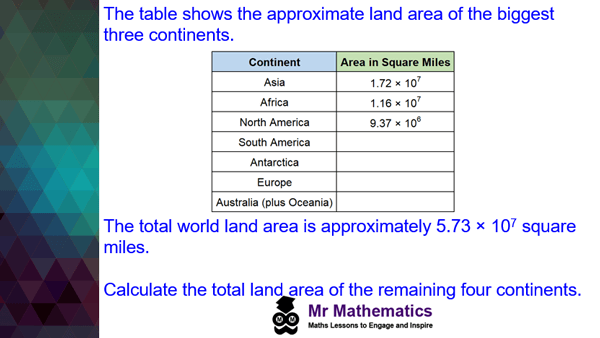
Prompts / Questions to consider
More able students could work with negative powers of ten and use approximations of one significant figure to check their solutions. Less able students could focus on the addition of large numbers using a single method.
Members of the site can download the full lesson. This includes:



Students learn to add and subtract numbers in standard form, aligning powers of ten before calculating. They apply this to real-world problems, such as total ocean volumes, and solve exam-style questions, like finding the median.


Students revise how to convert numbers between ordinary and standard forms.
As learning progresses, they perform addition and subtraction with numbers written in standard form.
Add and Subtract with Numbers in Standard Form
Revision Hub
Browse the Mr Mathematics Revision Hub for more maths revision lessons organised by topic and GCSE grade.
A research-backed case exploring why over-reliance on automated math homework platforms and repetitive worksheets lowers student expectations, and how departments can build genuine mathematical thinking.
How to teach converting between fractions, decimals and percentages.
Four problem solving lessons to develop student’s mathematical reasoning and communication skills.
