Home → Head of Maths Hub → Back to School Hub for Maths Teachers → Behaviour Management in a Mathematics Lesson
As we approach the start of the next term, I thought I would share some tips on behaviour management in a mathematics lesson. These are things that I have picked up over the years and have worked well for me. I am sure there are opposing viewpoints, and you may find some of these tips work for you and some don’t.
Engaging students in our lessons so their behaviour contributes to learning is often a top priority for new teachers. Try not to think of behaviour management as separate from teaching but rather as a direct result of it. An engaging and challenging lesson will create a positive learning environment more than any behaviour policy.
That said there are a couple of things you can do to set up an enjoyable lesson.
Get to know your students’ names as quickly as possible. Writing a seating plan is crucial to getting to know your students. How you arrange the plan depends on your teaching style and the needs of your class. Here are some standard seating plans for a mathematics lesson.
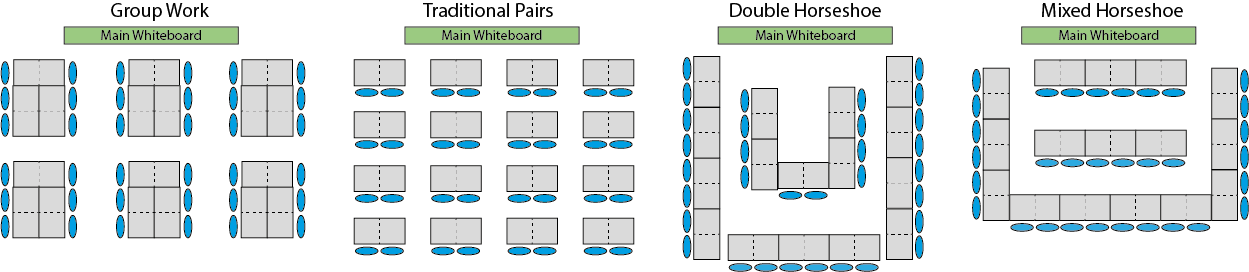
If you have never taught the class before or don’t know the students ask your mentor or a colleague to help you. They will be able to advise who works well with who and who to avoid sitting next to each other. You may also need to allow space for a teaching assistant. If your school uses ClassCharts you can sit students based on how they interact with others in the class.
Some students may forget where they sit, so make sure to check everyone is in the right place at the start of the lesson. Use your seating plan to address students by name as often as you can. This makes the students feel valued and helps them to understand the importance of sitting where they should be.
Consistency and reasonableness are key when teaching. Speak to your mentor about the school behaviour policy and get his/her advice on implementing it in your lessons. What works well for them and could work for you? When the students understand you know the school rules, they are less likely to challenge you.
The best behaviour policies are centred on praise and earning points for their House. Students should feel they must work hard to earn your praise, but when they do, you acknowledge their hard work consistently and fairly. It’s up to you to define what hard work is in your lessons. The students will soon pick up what they must do to earn your praise. Research shows the most effective praise vs sanction ratio for motivating people is about 6 : 1.
We all learn maths by doing maths. This is not a complicated idea, but it is so often overlooked by too much-directed teaching at the front of the class. We have all done it. As teachers, we want to ensure students understand what they need.
Look for ways to check their understanding at the start of the lesson. Mini-whiteboards, traffic lights and class discussions are all practical assessments to help you interact with students. The student planner often comes with a built-in mini-whiteboard and a set of traffic lights.
Knowing who can do what in the first 15 minutes of a lesson means you can focus your attention for the next 5 minutes on helping those who need it. You then have the rest of the lesson to watch your students learn so you can make the most of the plenary later on.
As I mentioned at the start of this blog, these things have worked for me regarding behaviour management in a mathematics lesson. You will have your own teaching style. As is so often with teaching, there is no single answer, especially to something as complex as behaviour management.
“Unlock a treasure trove of mathematical mastery! 🌟 Join now and gain access to over 800 comprehensive mathematics lessons tailored to propel your teaching to the next level.
Why wait? Enhance your curriculum and empower your students.
This post is part of our Back to School Hub for Maths Teachers – a full collection of back-to-school reading for the new academic year.
A research-backed case exploring why over-reliance on automated math homework platforms and repetitive worksheets lowers student expectations, and how departments can build genuine mathematical thinking.
How to teach converting between fractions, decimals and percentages.
Four problem solving lessons to develop student’s mathematical reasoning and communication skills.
